SonicWorld Plugins Telsie S V1.1.1 – (30 MB)

SonicWorld Plugins Telsie S V1.1.1​
File size: 29.3 MB​

The SonicWorld Telsie S is a 3-band equalizer plug-in based on the famous Siemens W295b discrete class A equalizer from the 1970s.

The W295b is known for its wonderfully airy highs and voluminous bass. Telsie S delivers this sound, along with some very useful upgrades compared to its analog counterpart!

Designed and built for the ARD (Association of German Public Broadcasters) in the 70´s, the Siemens mixing consoles reflected what was technically feasible at the time and were at the cutting edge of technology.
These mixing consoles were the direct successor for the tube-based V72/V76 mixing consoles.

Highly sought-after modules like the V276 Microphone Preamp and the W295 Series Equalizer were used in these consoles.

Siemens offered 3 different Equalizer versions: The W295, the W295a and the W295b which has the most elaborated design of the 3 models.

All these models share a low-shelf filter and high-shelf filter, while only the W295b features a mid-band with a presence/absence filter.

The W295b is still today the secret weapon of many engineers as it provides these VERY nice airy highs ..

At SonicWorld we know this analog marvel very well, as we have been servicing and racking many of these units in the last 20 years.

Interior of vintage Siemens W 295B Equalizer showing electronic components and control knobs.
Now you can have that sound without the crackle of old switches, dried-out capacitors, hard-to find transistors, etc.

The features of the Siemens W295b and Telsie S
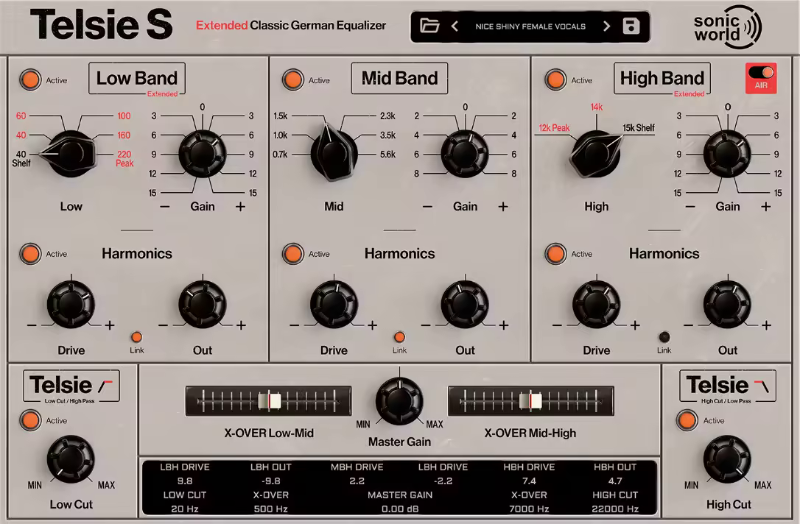
Similar to the original hardware device, the Telsie S is a three-band equalizer with shelf-filters on the high and low bands and a peak filter on the mid band. The low-shelf filter has its ±15 dB point at 40 Hz, while the high-shelf filter has its ±15 dB point at 15 kHz.

The mid-band is a presence/absence filter with Peak characteristics and 6 selectable center frequencies
0.7 kHz, 1 kHz, 1.5 kHz, 2.3 kHz, 3.5 kHz, and 5.6 kHz, and a maximum boost and cut of 8 dB each.
This peak filter has a proportional Q factor. This means that the width of the bell narrows the more dB you boost or cut.

The additional benefits of the Telsie S plug-in
Low Band Filter with additional frequencies
As an alternative to the original device’s low-shelf filter at 40 Hz, there are additional peak filter frequencies with center
frequencies at 40, 60, 100, 160 and 220 Hz.

These peak filters have a proportional Q factor, meaning the width of the bell narrows the more dB you boost or cut.
These additional peak filter frequencies give you significantly more sonic possibilities than the original shelf filter at 40 Hz.

High Band Filter with additional frequencies and AIR switch
The high band features the original device’s super nice- sounding high-shelf filter at 15 kHz. As an alternative Telsie S also offers two additional peak filters with center frequencies at 12 kHz and 14 kHz, with a maximum boost or cut of 15 dB in 3 dB steps.

The AIR switch significantly extends the high band’s frequency response. You can experiment with running your session at a higher sample rate to make this effect even more noticeable

Harmonics function
Each of the three equalizer bands has a harmonics function with two parameters: Drive and Out.
The Drive control allows you to adjust the amount of harmonics added to enrich the signal.
You can use the Out control to compensate for the increase in volume caused by the Drive section.
The two parameters are linked by default. You can disable this by using the Link switch.

Be careful when you do this as extreme boosts or cuts are possible.
Extreme boosts could not only harm your ears, but also your equipment.
We do not take responsibility for any potentional damage.

Low Cut/ High Pass and High Cut/Low Pass Filter
The Low Cut (High Pass) and the High Cut (Low Pass) filters are used to clean up the frequency range of your signal .
For example low rumble on an acoustic guitar or vocal track can be easily reduced with the Low Cut, or you can cut the high-frequency range for nasty frequencies.
Or with using both filters to give room for other tracks.
The cutoff frequency is freely selectable, both filters have a gentle slope of -12 dB per octave.

X-OverS Low Band/Mid Band and Mid Band/High Band
On the analog W295b, the high and low band curves are extremely broad. This means that a boost or cut in the 40 Hz shelf band has a sonic impact up to approximately 2 kHz. With the 15 kHz shelf band, a boost or cut has a sonic impact starting at around 200 Hz.
This characteristic never sounded appealing to us, as it often results in unwanted processed frequency ranges, even if you only want to boost or cut at much higher or lower frequencies.

This is where the two X-Over frequency controls come into play.
These allow you to set the respective frequency at which the Telsie S’s three equalizer bands merge.
The factory default crossover frequencies for the two crossover frequency controls are 500 Hz and 7 kHz.
This lets you give the presence band more space, even if you don’t want to boost or cut anything in this frequency range.

A close-up of a vintage control slider labeled "X-OVER Low-Mid" with a white knob and red indicator line, set at the middle position.
A linear alphanumeric control panel with a white slider and a red vertical line and the text ‘X-OVER Mid-High’ below.
This is very helpful for significantly influencing the equalizer curves and finding the right sound for different EQ requirements. You can boost for example with the low band a good amount at 220Hz or lower to give vocals a good basis and you can cut off unwanted higher frequencies at 400 Hz if you lower the X-over from 500 Hz down to 400 Hz.

The same goes for the high band. You can massively boost the high frequencies and avoid boosting unwanted frequencies at 7k if you set the X-Over Mid-High to a higher value than 7 kHz.

Try our EQ presets to find out how useful this feature is!

Master Gain and Parameter Bar
The Master Gain is used to compensate for level differences caused by equalization or harmonics.
Clicking the Master Gain control resets it to 0 dB.

The Parameter Bar displays the set values of the three harmonics bands LBH (Low Band Harmonics), MBH (Mid Band Harmonics), HBH (High Band Harmonics), the Low- and High-Cut filters, the chosen frequencies of the two X-overs and the Master Gain.

Whats New
Updates: official site does not provide any info about changes in this version

⋆🕷- – – – -☽───⛧ ⤝❖⤞ ⛧───☾ – – – -🕷⋆

SonicWorld Plugins Telsie S V1.1.1 – (30 MB)

RapidGator Link(s)
Code:Copy to clipboard

https://rapidgator.net/file/1a50cec22e9251095d3da0dac83ebfc9/SonicWorld.Plugins.Telsie.S.V1.1.1.rar

Freedl.ink Link(s)
Code:Copy to clipboard

https://frdl.io/5s64qzefihd0/SonicWorld.Plugins.Telsie.S.V1.1.1.rar
SonicWorld Plugins Telsie S 1.1.3

QUICK INFO: File size: 66.9 MB

DESCRIPTION: The SonicWorld Telsie S is a 3-band equalizer plug-in based on the famous Siemens W295b discrete class A equalizer from the 1970s.

The W295b is known for its wonderfully airy highs and voluminous bass. Telsie S delivers this sound, along with some very useful upgrades compared to its analog counterpart!

Designed and built for the ARD (Association of German Public Broadcasters) in the 70´s, the Siemens mixing consoles reflected what was technically feasible at the time and were at the cutting edge of technology.
These mixing consoles were the direct successor for the tube-based V72/V76 mixing consoles.

Highly sought-after modules like the V276 Microphone Preamp and the W295 Series Equalizer were used in these consoles.

Siemens offered 3 different Equalizer versions: The W295, the W295a and the W295b which has the most elaborated design of the 3 models.

All these models share a low-shelf filter and high-shelf filter, while only the W295b features a mid-band with a presence/absence filter.

The W295b is still today the secret weapon of many engineers as it provides these VERY nice airy highs ..

At SonicWorld we know this analog marvel very well, as we have been servicing and racking many of these units in the last 20 years.

Interior of vintage Siemens W 295B Equalizer showing electronic components and control knobs.
Now you can have that sound without the crackle of old switches, dried-out capacitors, hard-to find transistors, etc.

The features of the Siemens W295b and Telsie S
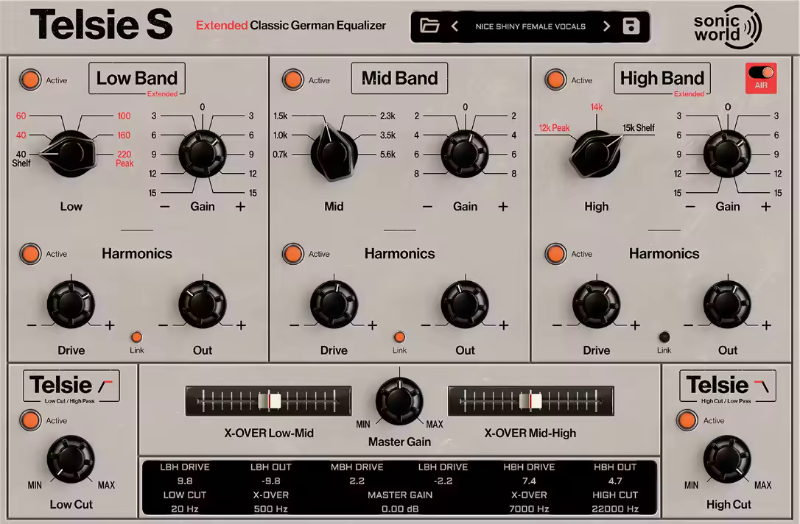
Similar to the original hardware device, the Telsie S is a three-band equalizer with shelf-filters on the high and low bands and a peak filter on the mid band. The low-shelf filter has its ±15 dB point at 40 Hz, while the high-shelf filter has its ±15 dB point at 15 kHz.

The mid-band is a presence/absence filter with Peak characteristics and 6 selectable center frequencies
0.7 kHz, 1 kHz, 1.5 kHz, 2.3 kHz, 3.5 kHz, and 5.6 kHz, and a maximum boost and cut of 8 dB each.
This peak filter has a proportional Q factor. This means that the width of the bell narrows the more dB you boost or cut.

The additional benefits of the Telsie S plug-in
Low Band Filter with additional frequencies
As an alternative to the original device’s low-shelf filter at 40 Hz, there are additional peak filter frequencies with center
frequencies at 40, 60, 100, 160 and 220 Hz.

These peak filters have a proportional Q factor, meaning the width of the bell narrows the more dB you boost or cut.
These additional peak filter frequencies give you significantly more sonic possibilities than the original shelf filter at 40 Hz.

High Band Filter with additional frequencies and AIR switch
The high band features the original device’s super nice- sounding high-shelf filter at 15 kHz. As an alternative Telsie S also offers two additional peak filters with center frequencies at 12 kHz and 14 kHz, with a maximum boost or cut of 15 dB in 3 dB steps.

The AIR switch significantly extends the high band’s frequency response. You can experiment with running your session at a higher sample rate to make this effect even more noticeable

Harmonics function
Each of the three equalizer bands has a harmonics function with two parameters: Drive and Out.
The Drive control allows you to adjust the amount of harmonics added to enrich the signal.
You can use the Out control to compensate for the increase in volume caused by the Drive section.
The two parameters are linked by default. You can disable this by using the Link switch.

Be careful when you do this as extreme boosts or cuts are possible.
Extreme boosts could not only harm your ears, but also your equipment.
We do not take responsibility for any potentional damage.

Low Cut/ High Pass and High Cut/Low Pass Filter
The Low Cut (High Pass) and the High Cut (Low Pass) filters are used to clean up the frequency range of your signal .
For example low rumble on an acoustic guitar or vocal track can be easily reduced with the Low Cut, or you can cut the high-frequency range for nasty frequencies.
Or with using both filters to give room for other tracks.
The cutoff frequency is freely selectable, both filters have a gentle slope of -12 dB per octave.

X-OverS Low Band/Mid Band and Mid Band/High Band
On the analog W295b, the high and low band curves are extremely broad. This means that a boost or cut in the 40 Hz shelf band has a sonic impact up to approximately 2 kHz. With the 15 kHz shelf band, a boost or cut has a sonic impact starting at around 200 Hz.
This characteristic never sounded appealing to us, as it often results in unwanted processed frequency ranges, even if you only want to boost or cut at much higher or lower frequencies.

This is where the two X-Over frequency controls come into play.
These allow you to set the respective frequency at which the Telsie S’s three equalizer bands merge.
The factory default crossover frequencies for the two crossover frequency controls are 500 Hz and 7 kHz.
This lets you give the presence band more space, even if you don’t want to boost or cut anything in this frequency range.

A close-up of a vintage control slider labeled "X-OVER Low-Mid" with a white knob and red indicator line, set at the middle position.
A linear alphanumeric control panel with a white slider and a red vertical line and the text ‘X-OVER Mid-High’ below.
This is very helpful for significantly influencing the equalizer curves and finding the right sound for different EQ requirements. You can boost for example with the low band a good amount at 220Hz or lower to give vocals a good basis and you can cut off unwanted higher frequencies at 400 Hz if you lower the X-over from 500 Hz down to 400 Hz.

The same goes for the high band. You can massively boost the high frequencies and avoid boosting unwanted frequencies at 7k if you set the X-Over Mid-High to a higher value than 7 kHz.

Try our EQ presets to find out how useful this feature is!

Master Gain and Parameter Bar
The Master Gain is used to compensate for level differences caused by equalization or harmonics.
Clicking the Master Gain control resets it to 0 dB.

The Parameter Bar displays the set values of the three harmonics bands LBH (Low Band Harmonics), MBH (Mid Band Harmonics), HBH (High Band Harmonics), the Low- and High-Cut filters, the chosen frequencies of the two X-overs and the Master Gain.

Whats New
Updates: official site does not provide any info about changes in this version

⋆🕷- – – – -☽───⛧ ⤝❖⤞ ⛧───☾ – – – -🕷⋆

SonicWorld Plugins Telsie S 1.1.3 (67 MB)

RapidGator
Code:Copy to clipboard

https://rapidgator.net/file/ae02c4108bcef3d6995673063d63354c/SonicWorld.Plugins.Telsie.S.1.1.3.rar

Freedl.ink
Code:Copy to clipboard

https://frdl.io/k7g36m6sj029/SonicWorld.Plugins.Telsie.S.1.1.3.rar

Soniccouture – Flowstate

Format : Contact (7.10.2+), Contact Player
Quality : stereo/mono 96/48/44.1 kHz 24/16 bits
Description: The mechanism of harmonic morphin Transform. Dilige. Convert.
Flowstate will instantly turn any audiolip into a flexible, changing musical form. Drag the audio files to create morphing textures, moving between 5 different harmonic conditions. From drum loops to pure noise – everything can be transformed into a lively and rich sound landscape. Created for your audio
FlowState contains 100 stops + samples. But in fact, it was created to drag. Take any audio -emergency you have a field record, Breikbit, a fragment of the track – and see what FlowState can turn it. Peculiarities
Harmonic morphine mechanism
D justified audio
100 presets
Support NKS

⋆🕷- – – – -☽───⛧ ⤝❖⤞ ⛧───☾ – – – -🕷⋆

Soniccouture – Flowstate (587.09 MB)

Drop Link(s)
Code:Copy to clipboard

https://drop.download/59hmmrhr1bzp/Flowstate.Soniccouture.rar

RapidGator Link(s)
Code:Copy to clipboard

https://rapidgator.net/file/72e3a51394ebdd02d7a83d9344a6ea77/Flowstate.Soniccouture.rar

Soniccouture – Flowstate 1.1.0 Full + Update (kontakt)

Format : kontakt (7.10.2+)
Quality : Stereo/mono 96/48/44.1 kHz 24/16 bit

Description: Harmonic morphing mechanism Transform. Melt. Distort.
Flowstate instantly transforms any audio clip into a flexible, fluid musical form. Drag and drop audio files to create morphing textures, moving between 5 different harmonic states. From drum loops to pure noise, everything can be transformed into a vibrant, rich soundscape. Designed for your audio
Flowstate comes with 100 presets + samples. But it’s really designed for drag and drop. Take any audio sample you have – a field recording, a breakbeat, a track fragment – and see what Flowstate can turn it into.

Peculiarities
Harmonic morphing mechanism
Drag and drop audio
100 presets
NKS support

⋆🕷- – – – -☽───⛧ ⤝❖⤞ ⛧───☾ – – – -🕷⋆

Soniccouture – Flowstate 1.1.0 Full + Update (kontakt)
RapidGator Link(s)
Code:Copy to clipboard

https://rapidgator.net/file/f190ef270e21ffc7d38d17cbbe6f5f07/Flowstate.1.1.0.Soniccouture.rar

ClickNUpload Link(s)
Code:Copy to clipboard

https://clicknupload.click/93wfdithc3qb

Sonicbits Exakt 1.3.0

File size: 3.6 MB​

FM synths hold a special place in the history of synthesizers. Exakt, the intuitive and easy-to-use FM synthesizer plugin is designed to make FM synthesis more accessible.

As many vintage machines, Exakt has got 4 operators which can be arranged in various FM algorithms. Each operator has got different waveforms such as the basic sine, saw, square and triangle. Then apart from the 8 classic waveforms from the Yamaha TX81Z, four additional enhanced TX waveforms are included.
Each operator has got its own amplitude envelope generator supporting the 5 point TX envelopes. These envelopes have been modeled to mimic the TX characteristics. Additionally, up to 16 points can be added to the loopable envelopes in order to create complex shapes.
Combined with a flexible modulation matrix, a creamy chorus, gritty distortion and a stereo delay effect, Exakt has got sounds that can be used in all types of music.

Detailed Specs
4 aliasing free Operators with classic and enhanced TX waveforms
16 voice polyphony
Drag-and-drop envelopes with up to 16 points and copy and paste
Envelope loops
16 FM algorithms with feedback on operator D
Linked editing of all 4 operators at once
Resonant filter with different lowpass, highpass and bandpass models
Formant filter with vowel emphasis
Visualization of the resulting waveform for immediate editing response
2 LFOs syncable to host
2 loopable modulation envelopes with up to 16 points
Mod matrix with many targets
Lush chorus, distortion and stereo delay effects
12-bit DAC emulation
Sysex bank import from Yamaha 4 operator synthesizers (experimental)
Over 150 ready to play presets organized in categories including presets from Venus Theory and Warkauze
Blur free vector graphics resizing

Whats New
•Add: A new reverb effect has been inserted after the delay.
•Add: 20 new presets.
•Update: All effect mix levels are now displayed with the dry/wet ratio.
•Fix: Parameters, operator and modulation envelope states would not be saved in the DAW session. This has been fixed.
•Fix: In mono mode, the glide was not applied correctly. This has been fixed.
•Fix: Operator level modulation values were not applied correctly. This has been fixed.
•Fix: The voice management for some FM algorithms was wrong. This has been fixed.
•Fix: Under some conditions, the DAC sample rate conversion worked on one channel only. This has been fixed.
•Fix: The sysex import mapping to the parameters has been improved. The operator levels and their envelope settings are closer to the hardware.
•Fix: The performance of the AU version for the Apple ARM platform has been improved.
•Fix: The Windows setup now first asks for the plugin formats to be installed and then only for the paths of the selected formats.
•Fix: Under some circumstances, when the unregistered plugin UI was hidden, it would crash when the audio was muted. This has been fixed.
•Fix: General fixes and performance optimizations.

Code:Copy to clipboard

https://www.sonicbits.com/plugins/exakt

⋆🕷- – – – -☽───⛧ ⤝❖⤞ ⛧───☾ – – – -🕷⋆

Sonicbits Exakt 1.3.0 (3.61 MB)

UsersDrive Link(s)
Code:Copy to clipboard

https://usersdrive.com/gdmlvn9g4843.html

RapidGator Link(s)
Code:Copy to clipboard

https://rapidgator.net/file/86c6a2778ae8fe2a48211706e935d268/Sonicbits.Exakt.V1.3.0.BUBBiX.rar

Sonica Instruments – Tsugaru Shamisen v2.0.0 (Kontakt)

Format : Contact (6.6.0+)
Quality : Stereo 44.1 kHz 24 bit

Description : Tsugaru-jamisen is a type of shamisen, a Japanese fretless three-string lute …the description is being updated… Sonica Instruments has painstakingly recreated every aspect of the revered tsugaru shamisen – the stirring percussive sounds, the powerful playing techniques, and the blazing speed of hajiki picking – in a Kontakt instrument library.
The Virtuoso Japanese Series’ TSUGARU SHAMISEN library is certain to enliven nearly every genre of music, from Japanese minyo folk songs to hard rock, jazz, contemporary classical music, and movie scores. Peculiarities
Perfectly recreates the sound of the tsugaru shamisen with the best possible recording and programming techniques.
Completely natural picking sounds by virtue of up to five velocity layers and as many as 12 round robins.
Covers more than 20 tsugaru shamisen playing techniques, all key-switch controllable.
Five key-switch controllable phrase banks containing a wide array of essential tsugaru shamisen phrases.
The newly developed String Mode Mechanism – which lets you select which string to play – provides rich expressiveness and realism with the same feel as an actual shamisen.
Reproduces the resonance buzz of the azuma sawari inherent to the tsugaru shamisen that operates in the same way as the real thing.
Three selectable tuning modes for ni-agari, honchoshi, and san-sagari tunings.
The open string notes, sawari effects, and resonant tones are adjusted automatically to match all tunings and key transpositions.
The alternate picking function reproduces sequences of downstrokes and upstrokes.
The Hajiki-Legato function allows you to play hajiki sounds instantly with Legato.
The plucking control function provides realistic attack nuances.
The built-in Instrument Editor provides string-by-string tuning and volume adjustments.
Lively powerful sounds sampled in full 24-bit 96 kHz fidelity (the library contains 24-bit 44.1 kHz samples).
Create your own mixes with the multi-microphone samples and a dedicated mixer with individual controls for Direct, Overhead, Room, and Stereo Mix.
NKS ready and Kontakt Player compatible.

⋆🕷- – – – -☽───⛧ ⤝❖⤞ ⛧───☾ – – – -🕷⋆

Sonica Instruments – Tsugaru Shamisen v2.0.0 (Kontakt) (6.51 GB)
RapidGator Link(s)
Code:Copy to clipboard

https://rapidgator.net/file/16fc9a38d07f825ad6fd4d448ddd0b5d/Tsugaru.Shamisen.2.0.0.Sonica.Instruments.part1.rar
https://rapidgator.net/file/f1977be1f862d48da94126c480b6b4cf/Tsugaru.Shamisen.2.0.0.Sonica.Instruments.part2.rar
https://rapidgator.net/file/a188912d49492fbf2b45c75b233b5a88/Tsugaru.Shamisen.2.0.0.Sonica.Instruments.part3.rar
https://rapidgator.net/file/08f8cf30700c85ba4865821d57e50a62/Tsugaru.Shamisen.2.0.0.Sonica.Instruments.part4.rar

Drop Link(s)
Code:Copy to clipboard

https://drop.download/am90d6lx6rpf/Tsugaru.Shamisen.2.0.0.Sonica.Instruments.part1.rar
https://drop.download/xnju1ohzqjk6/Tsugaru.Shamisen.2.0.0.Sonica.Instruments.part2.rar
https://drop.download/ejn9fflduznd/Tsugaru.Shamisen.2.0.0.Sonica.Instruments.part3.rar
https://drop.download/j9tj7gontzdi/Tsugaru.Shamisen.2.0.0.Sonica.Instruments.part4.rar

Sonica Instruments – Sho v2.0.0 (Kontakt)

Format : Contact (6.6.0+)
Quality : Mono 44.1 kHz 24 bit

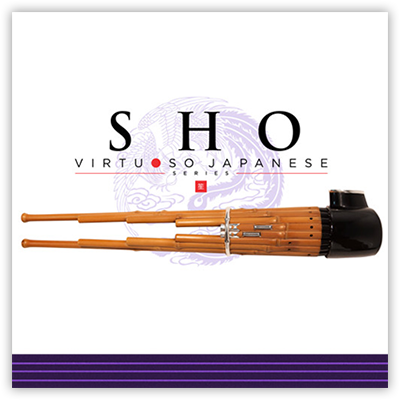
Description : Sho is a Japanese wind reed musical instrument. …the description is being updated… The sho is free reed musical instrument and one of the three primary woodwind instruments used in gagaku court orchestra music. Consisting of 17 slender bamboo pipes, it is sometimes said to resemble a resting phoenix because of its shape. In antiquity, the sho’s fluid tonal character was associated with light shining down from the heavens.
After completing the world’s first comprehensive sho sampling, Sonica Instruments is proud to add the SHO library to the Virtuoso Japanese Series. Peculiarities
Peerless recordings of the impeccable sound and technique of famed sho performer Ko Ishikawa.
Single tones of all 15 pipes* and 11 chords sampled separately in every articulation, making the library applicable to all musical styles from gagaku to contemporary music.
A detailed analysis of sho playing techniques led to an instrument model that allows playing any combination of the sho’s distinctive tone clusters (chords) and single tones.
Two key modes, including a traditional fingering mode that replicates actual sho fingering with one key per pipe.
Pipe Indicator lets the performer see the pipe arrangement of the sho and monitor the current pipes being played.
Comes with traditional sho Pythagorean tuning, equal temperament tuning, and fully customizable tunings, for seamless coverage of both classical and contemporary scale tones.
Unique Key Trigger Connection function lets the performer move through a colorful assortment of articulations without ever interrupting the sound.
Expression control adjusts tone color naturally and continuously without gradations.
Ensemble selector simulates gagaku ensemble performances with up to three performers.
The library’s lively yet subtle sounds sampled in full 24-bit 96 kHz fidelity (the library itself contains 24-bit 44.1 kHz samples).
Create your own mixes with the multi-microphone samples and a dedicated mixer with individual controls for Direct, Overhead, Room, and Stereo Mix.
NKS ready and Kontakt Player compatible.

⋆🕷- – – – -☽───⛧ ⤝❖⤞ ⛧───☾ – – – -🕷⋆

Sonica Instruments – Sho v2.0.0 (Kontakt) (2.21 GB)
RapidGator Link(s)
Code:Copy to clipboard

https://rapidgator.net/file/ad806df883e310b619554f68cfd96c29/Sho.2.0.0.Sonica.Instruments.part1.rar
https://rapidgator.net/file/43b6c88e463974f8ff9e0d21e7ee5bf9/Sho.2.0.0.Sonica.Instruments.part2.rar

Drop Link(s)
Code:Copy to clipboard

https://drop.download/gde8ltzlr0ed/Sho.2.0.0.Sonica.Instruments.part1.rar
https://drop.download/d9k1iab174wa/Sho.2.0.0.Sonica.Instruments.part2.rar

Sonica Instruments – Shakuhachi v2.0.0 (Kontakt)

Format : Contact (6.6.0+)
Quality : Mono 44.1 kHz 24 bit

Description : Shakuhachi is a traditional Japanese longitudinal bamboo flute …the description is being updated… Singing sonorous intonation, deep yet delicate breathing, and a Japanese sound aesthetic spilling into the periphery: The shakuhachi – an instrument symbolic of Japan – finally joins the Virtuoso Japanese Series family. Peculiarities
Precisely captures the scintillating sounds of a veteran shakuhachi player, covering every playing technique and recorded with exacting attention to detail at every musical interval.
Features performance mechanisms designed specifically for this library to recreate the full dynamics of this wind instrument, from the softest sound to the most emphatic pitch.
The unique Key Trigger Connection function lets the performer move through a colorful assortment of articulations without ever interrupting the sound.
Legato and grace note controls reproduce complex fingering techniques such as atari, uchi, and oshi.
The blow control function lets the performer manipulate the duration from the breath noise to the actual tone with either a controller.
The expression control varies the tone color naturally and continuously without gradations.
A hybrid combination of the shakuhachi (1.8 shakuhachi) and the 2.3 shakuhachi provides a wider register, including lower tones, and more tone color variations.
Create traditional shakuhachi pitch scales, as well as performer-specific pitch scales, with the Scale Tuning function, which provides individual note adjustment over G2 to B5.
Five phrase banks contain a wide array of essential shakuhachi phrases.
Lively powerful sounds sampled in full 24-bit 96 kHz fidelity (the library itself contains 24-bit 44.1 kHz samples).
Create your own mixes with the multi-microphone samples and a dedicated mixer with individual controls for Direct, Overhead, Room, and Stereo Mix.
NKS ready and Kontakt Player compatible.

⋆🕷- – – – -☽───⛧ ⤝❖⤞ ⛧───☾ – – – -🕷⋆

Sonica Instruments – Shakuhachi v2.0.0 (Kontakt) (5.33 GB)
RapidGator Link(s)
Code:Copy to clipboard

https://rapidgator.net/file/8f8e5f9f94297f7ad33354c6113c2d83/Shakuhachi.2.0.0.Sonica.Instruments.part1.rar
https://rapidgator.net/file/888f0b801b52a4a3421b91a30be00d3a/Shakuhachi.2.0.0.Sonica.Instruments.part2.rar
https://rapidgator.net/file/cdfcac86cf909a274269d20b400dd446/Shakuhachi.2.0.0.Sonica.Instruments.part3.rar

Drop Link(s)
Code:Copy to clipboard

https://drop.download/bb1gu65rrvei/Shakuhachi.2.0.0.Sonica.Instruments.part1.rar
https://drop.download/ot1h4fzx2063/Shakuhachi.2.0.0.Sonica.Instruments.part2.rar
https://drop.download/s0b6h9wdisuw/Shakuhachi.2.0.0.Sonica.Instruments.part3.rar

Sonica Instruments – Koto 17 v2.0.0 (Kontakt)

Format : Contact (6.6.1+)
Quality : Stereo 96 kHz 24 bit

Description : Koto is a Japanese plucked musical instrument, a long zither with movable fillies Koto 17 , the seventh installment in the Virtuoso Japanese Series , introduces music creators to the sound of the 17-string bass koto , an integral part of modern Japanese music.
Three years after the release of Koto 13 , Koto 17 introduces expanded functionality to take advantage of the library’s new tonal qualities.
Koto 17 can, of course, be used as a solo instrument. But it complements Koto 13 and Shakuhachi perfectly , making it an indispensable component in both classical and modern Japanese music. And when combined with other Virtuoso Japanese Series instruments, the Koto 17 completes this incredibly powerful ensemble. Peculiarities
Flawless reproduction of every nuance of a 17-string koto performance thanks to carefully thought-out recording techniques and innovative programming
mode Performance maps 17 strings to adjacent white keys for easy playing of glissandos and phrases
20 fundamental articulations selectable via key switch
Sustain pedal control for natural, continuous phrasing
Instrument Modeler reproduces sound variations corresponding to different plectrums and strings
Character selector allows you to select three plectrum thicknesses
selector Tone offers three string tones: Thick , Normal and Thin
Three banks of the most characteristic koto phrases, controlled via a key switch
Plucking Control allows you to control delicate, natural-sounding notes
String editor allows you to independently tune all 17 strings
In addition to 10 preset scales, User Scale mode allows you to create your own
Create your own mixes using multi-microphone samples and a dedicated mixer with individual controls for Direct , Overhead , Room and Stereo Mix channels
Compatible with NKS and Kontakt Player Code:Copy to clipboard

https://sonica.jp/instruments/images/KOTO17_v2.0_Manual_E.pdf

Guide (PDF) | Other Sonica Instruments libraries for Kontakt

⋆🕷- – – – -☽───⛧ ⤝❖⤞ ⛧───☾ – – – -🕷⋆

Sonica Instruments – Koto 17 v2.0.0 (Kontakt) (13.96 GB)
RapidGator Link(s)
Code:Copy to clipboard

https://rapidgator.net/file/dcb1a61f5e085cfc2327ed200726a63c/Koto.17.v2.0.0.Sonica.Instruments.part1.rar
https://rapidgator.net/file/c9fbe7149a1f2e52df02d6245bc21763/Koto.17.v2.0.0.Sonica.Instruments.part2.rar
https://rapidgator.net/file/b34c0724b85db2d4381f33e7c851f419/Koto.17.v2.0.0.Sonica.Instruments.part3.rar
https://rapidgator.net/file/f832ba4fb833380d1d3779f755f57a1f/Koto.17.v2.0.0.Sonica.Instruments.part4.rar
https://rapidgator.net/file/24ff096173d52e62931559738015d325/Koto.17.v2.0.0.Sonica.Instruments.part5.rar
https://rapidgator.net/file/f83be81416585a9f62fdf92abc6fbffb/Koto.17.v2.0.0.Sonica.Instruments.part6.rar
https://rapidgator.net/file/62211183b95f9240a2dc365dceb9349a/Koto.17.v2.0.0.Sonica.Instruments.part7.rar
https://rapidgator.net/file/4a78f3ed0feb632ec5074da4387b694a/Koto.17.v2.0.0.Sonica.Instruments.part8.rar

Drop Link(s)
Code:Copy to clipboard

https://drop.download/6t9wv2ckez3g/Koto.17.v2.0.0.Sonica.Instruments.part1.rar
https://drop.download/6adx7qhb76xu/Koto.17.v2.0.0.Sonica.Instruments.part2.rar
https://drop.download/2mjpk3u14k4q/Koto.17.v2.0.0.Sonica.Instruments.part3.rar
https://drop.download/zoxjmmji4x65/Koto.17.v2.0.0.Sonica.Instruments.part4.rar
https://drop.download/dh7guuj77hgy/Koto.17.v2.0.0.Sonica.Instruments.part5.rar
https://drop.download/gfpc95kb6fgo/Koto.17.v2.0.0.Sonica.Instruments.part6.rar
https://drop.download/4zhsrzyugrw8/Koto.17.v2.0.0.Sonica.Instruments.part7.rar
https://drop.download/wvo98r7w6cc2/Koto.17.v2.0.0.Sonica.Instruments.part8.rar

Sonic Projects OP X PRO 3 V1.0.3 – (23 MB)

Sonic Projects OP X PRO 3 V1.0.3​
Team R2R | 03 Nov 2025 | 50.9MB​

OP-X PRO-3 is a 12-voice semi-modular virtual analog synth based on OP-X PRO-II which includes all sounds and features of OP-X PRO-II and fullfills virtually all requests and wishes from users collected over the recent years.

Due to its massive features and flexibility OP-X PRO-3 is able to emulate the typical sounds of almost ANY analog synth of the late 70s and 80s including OB-X, Matrix-12, Jupiter-8, Prophet-5 and even Minimoog.

The synth offers
12 independent voices on separate tunable voice-boards.
A newly arranged logically structured interface.
Improved audio quality preserving the beloved character.
10 filter types with seamless morphing.
5 envelopes (4 poly, 1 mono).
4 LFOs (3 global, 1 per-voice, so x12).
Modulation Matrix offering 5 slots (2 poly, 3 mono).
Sample & hold and sampled vibrato.
Hard-wired key tracking for pulse width modulation.
2 Oscillators offering Sawtooth, Pulse, Sine and Triangle.
DCO or VCO behaviour seamlessly blendable.
Sync, X-Mod, Ringmod and Sine-FM.
An inside access to the 12 voice boards and linked units.
Voice-boards resettable on song start.
Reverb and syncable Delay (normal, triolic, dotted).
Modulation unit (Chorus, Flanger, Phaser, Ensemble) adopted from Stringer
A new patch browser offering search, favourites and tagging.
Arpeggiator offering 32 modes and a new always on digital display.
Preset Chords, Chord Hold, 8-Step Sequencer.
Switchable off hands-free hold by pedal.
Unison offering last, lowest and highest note priority.
MIDI Learn now offering one source to multiple destinations.
Relative or fetched CC processing for jump-free operation.
Pitchbend interval and mode separatly settable for up/down.
Modwheel modes separatly settable.
Pitchwheel and Modwheel fully detachable for Matrix mapping.
Logically restructured interface and no hidden features.
Switchable GUI size offering reality proven sizes.
Blue and dark skin re-skinning option.
Includes an alphabetic library of 475 famous 80s sounds.
Includes 3’000 first class patches with an estimated value of $600.

The same as its precedessors did since 2006 the synth engine of OP-X PRO-3 exactly clones the inner working of real voltage controlled polyphonic analog synths of the late 70s and 80s in every tiny detail.

This includes that each voice is a completely independend mono-synth sitting on a separate circuit board or in a separate circuit section on a common board and features tuning trimpots to wipe-out the differences caused by device tolerances which usually was done by a technician prior to shipping.

For the user the synths usually offered an autotune function which sent an offset voltage to the voice boards to flatten differences which again could arise caused by warm-up drift and thermal shifting of the trimpots and devices. Early synths only offered this for oscillater pitch, but later synths like Matrix-12 also for filters and other parameters.

This is offered too in OP-X PRO-3 and the same as in the originals you usually manage the tuning only uning the atotune unit and not by tweaking trimpots everytime which would be cubersome, but with the advantage that you can go forth and back (so tune and detune again) and even can tune or detune seamlessly, so seamlessly blend between the tuned and detuned state.

The detuned state (so no autotune offset voltage applied) the same as in the originals is represented by the settings of the trimpots on the boards. In freshly soldered state these all are in 12 o’clock setting since all come in the same setting from the factory. So other than one would suppose 12 o’clock doesn’t mean tuned.

For tuning the boards the service technician then had to tweak the trimpots out of their original factory state until the voices sounded even, usually comparing to a reference voice. So after this tuning procedure the trimpots then had various settings.

The great thing in OP-X PRO-3 is that you can save such a base setting with the patch. Which means it can be diferent for each patch which of course wasn’t possible in the originals. Normally the implemented standard detuning (12’oclock state of the trimpots) is perfectly usable (it was cloned from an actual synth) and the only thing to do is to use autotune to switch or blend between the detuned and tuned state. But if you like you can edit this base detuning state to your liking by tweaking the trimpots.

This all makes OP-X PRO-3 act exactly the same as real voltage controlled polyphonic analog synths in every tiny detail but with the flexibility and recall options which the digital domain offers. Which probably was a dream in the old days.

Whats new in this version
Official site does not provide any info about changes in this version.

System Requirements

⋆🕷- – – – -☽───⛧ ⤝❖⤞ ⛧───☾ – – – -🕷⋆

Sonic Projects OP X PRO 3 V1.0.3 – (23 MB)
RapidGator Link(s)
Code:Copy to clipboard

https://rapidgator.net/file/4f641585c8e1a3a449fc1e0731b385ec/Sonic.Projects.OP.X.PRO.3.V1.0.3.rar

ClickNUpload Link(s)
Code:Copy to clipboard

https://clicknupload.click/f2zptftldi5v