Golang Developer Course in 2024


Last updated 9/2024 Created by John Cheong MP4 | Video: h264, 1920×1080 | Audio: AAC, 44.1 KHz, 2 Ch Level: All Levels | Genre: eLearning | Language: English | Duration: 149 Lectures ( 7h 45m ) | Size: 3.41 GB​

Master Go: Concurrency, Performance, and Simplicity – Become a Golang Pro and Build Scalable Software.

What you’ll learn
✓ Learn the core Go skills needed to apply for GO developer positions in just a few hours.
✓ Understand how to create your own Go programs.
✓ Be able to demonstrate industry best practices in the Go programming language code you write.
✓ Understand concurrency, channels, benchmarking
✓ Understand Go concepts so well that you can explain them to other engineers!

Requirements
Basic understanding of programming will help but is not required.
Computer with an internet connection is required

Description
Welcome to our comprehensive Golang course, where you’ll embark on an exciting journey to become a proficient Go programmer. This course is meticulously crafted to provide you with a solid foundation in Go programming, along with the advanced skills needed to build efficient, scalable, and concurrent applications.

Starting from the basics, we’ll guide you through the fundamental concepts of Go, including its clean and concise syntax, data types, variables, control structures, and functions. With hands-on exercises and coding challenges, you’ll gain a deep understanding of how to write clean and idiomatic Go code.

As you progress, we’ll delve into more advanced topics that set Go apart from other programming languages. You’ll explore the power of Go’s built-in concurrency model, learning how to leverage goroutines and channels to achieve parallel execution and maximize performance. Additionally, you’ll master error handling techniques, explore advanced data structures, and understand effective strategies for testing and debugging your Go programs.

But it doesn’t stop there. Our course goes beyond the core language features. You’ll also dive into web development with Go, building robust APIs and web applications using popular frameworks like Gin.

Throughout the course, you’ll benefit from real-world examples, best practices, and industry insights shared by our experienced instructors. You’ll also have the opportunity to collaborate with fellow learners, enhancing your skills through group projects and code reviews.

Whether you’re a beginner starting your programming journey or an experienced developer looking to add Go to your skill set, this course provides the roadmap to becoming a Go pro. Join us and unlock the full potential of Go as you elevate your software development career.

Who this course is for
â Engineers who want to pick up the Golang Language quickly!

Welcome to – Check it Every Days
If you have any troubles with downloading, PM me

Happy Learning!! Click to expand…

RapidGator
Code:Copy to clipboard

https://rapidgator.net/file/d12d69ee4a0643cb104ea7c031cdcbdd/
https://rapidgator.net/file/1fdc72eaab0daad093423245a0ab3c8b/
https://rapidgator.net/file/ef23989ba3f8713b6c35306e053029ff/
https://rapidgator.net/file/d0a699d8976c0f17b805381b06141446/

DDownload
Code:Copy to clipboard

https://ddownload.com/ann452aeeju8
https://ddownload.com/bwode50qrjx8
https://ddownload.com/he7lzmtx9x1i
https://ddownload.com/fqul7ea3qtc4

<—====All Premium====—>
DDownload
Code:Copy to clipboard

https://ddownload.com/gxktnvh3xz2x
https://ddownload.com/lpc4imv8umjr
https://ddownload.com/yamk3lomjp1k
https://ddownload.com/ya69jljk17sl

UsersDrive
Code:Copy to clipboard

https://usersdrive.com/imi24omrob3f
https://usersdrive.com/yikvukacw522
https://usersdrive.com/06de7lz51bkn
https://usersdrive.com/i1gw9c76y40n

Go: The Complete Developer’s Guide (Golang)


Go: The Complete Developer’s Guide (Golang)
MP4 | Video: AVC 1280×720 | Audio: AAC 44KHz 2ch | 91 lectures | 8h 55m Duration | 6.98 GB
Genre: eLearning | Language: English​

Master the fundamentals and advanced features of the Go Programming Language (Golang)

Go is an open source programming language created by Google.
As one of the fastest growing languages in terms of popularity, its a great time to pick up the basics of Go!

This course is designed to get you up and running as fast as possible with Go. We’ll quickly cover the basics, then dive into some of the more advanced features of the language.
Don’t be tricked by other courses that only teach you for-loops and if-statements!
This is the only course on Udemy that will teach you
how to use the full power
of Go’s concurrency model and interface type systems.

Go is designed to be easy to pick up, but tough to master. Through multiple projects, quizzes, and assignments, you’ll quickly start to master the language’s quirks and oddities. Go is like any other language – you have to write code to learn it! This course will give you ample opportunities to strike out on your own and start working on your own programs.

In this course you will:

Understand the
basic syntax and control structures
of the language
Apply Go’s
concurrency model
to build massively parallel systems
Grasp the
purpose of types,
which is especially important if you’re coming from a dynamically typed language like Javascript or Ruby
Organize code through the use of
packages
Use the Go runtime to build and compile projects
Get insight into
critical design decisions
in the language
Gain a sense of when to use basic language features

Go is one of the fastest-growing programming languages released in the last ten years. Get job-ready with Go today by enrolling now!

RapidGator
Code:Copy to clipboard

https://rapidgator.net/file/ea35b5af81121f1de09f4db15eb16e64/UDEMY.Go.The.Complete.Developer.s.Guide.Golang.2026.BOOKWAREMiMiR.part1.rar
https://rapidgator.net/file/74eb169d06f60e49e41089adaae3d610/UDEMY.Go.The.Complete.Developer.s.Guide.Golang.2026.BOOKWAREMiMiR.part2.rar
https://rapidgator.net/file/2ff8de2f1c99ed33294550846238da3d/UDEMY.Go.The.Complete.Developer.s.Guide.Golang.2026.BOOKWAREMiMiR.part3.rar
https://rapidgator.net/file/fc55ccead3254275e917702d926879ab/UDEMY.Go.The.Complete.Developer.s.Guide.Golang.2026.BOOKWAREMiMiR.part4.rar
https://rapidgator.net/file/475181dc47563fba0c913fc6414bb436/UDEMY.Go.The.Complete.Developer.s.Guide.Golang.2026.BOOKWAREMiMiR.part5.rar
https://rapidgator.net/file/e35029b267c6d4f2b7114d4b35890528/UDEMY.Go.The.Complete.Developer.s.Guide.Golang.2026.BOOKWAREMiMiR.part6.rar

DDownload
Code:Copy to clipboard

https://ddownload.com/wygxpn6hhbey/UDEMY.Go.The.Complete.Developer.s.Guide.Golang.2026.BOOKWAREMiMiR.part1.rar
https://ddownload.com/mxrkbvc93grh/UDEMY.Go.The.Complete.Developer.s.Guide.Golang.2026.BOOKWAREMiMiR.part2.rar
https://ddownload.com/vk8la1iqvs4m/UDEMY.Go.The.Complete.Developer.s.Guide.Golang.2026.BOOKWAREMiMiR.part3.rar
https://ddownload.com/4s810ptvgb0m/UDEMY.Go.The.Complete.Developer.s.Guide.Golang.2026.BOOKWAREMiMiR.part4.rar
https://ddownload.com/ld0vd2l3ygw2/UDEMY.Go.The.Complete.Developer.s.Guide.Golang.2026.BOOKWAREMiMiR.part5.rar
https://ddownload.com/u8thcawo4hgs/UDEMY.Go.The.Complete.Developer.s.Guide.Golang.2026.BOOKWAREMiMiR.part6.rar

<—====All Premium====—>
UsersDrive
Code:Copy to clipboard

https://usersdrive.com/e6t674luda8u/UDEMY.Go.The.Complete.Developer.s.Guide.Golang.2026.BOOKWAREMiMiR.part1.rar
https://usersdrive.com/qhcocjrgtmez/UDEMY.Go.The.Complete.Developer.s.Guide.Golang.2026.BOOKWAREMiMiR.part2.rar
https://usersdrive.com/5swhucgsg31s/UDEMY.Go.The.Complete.Developer.s.Guide.Golang.2026.BOOKWAREMiMiR.part3.rar
https://usersdrive.com/0b9130826aua/UDEMY.Go.The.Complete.Developer.s.Guide.Golang.2026.BOOKWAREMiMiR.part4.rar
https://usersdrive.com/g8fo5t1dmfpl/UDEMY.Go.The.Complete.Developer.s.Guide.Golang.2026.BOOKWAREMiMiR.part5.rar
https://usersdrive.com/56tcei7xm8fy/UDEMY.Go.The.Complete.Developer.s.Guide.Golang.2026.BOOKWAREMiMiR.part6.rar

Go (Golang) Programming: The Complete Go Bootcamp 2023


Last updated 3/2023 MP4 | Video: h264, 1280×720 | Audio: AAC, 44.1 KHz Language: English | Size: 6.20 GB | Duration: 19h 22m​

Master Go (Golang) from Beginner to Pro. Become a Professional Golang Programmer from Scratch. Learning by doing!

What you’ll learn
Become a professional Go programmer and get hired.
You will MASTER all Go (Golang) key concepts starting from scratch. No prior Go knowledge is required.
For each Go key concept you’ll get HD Videos, coding sections, quizzes, practice exercises with solutions and slides.
Build a COMPLETE understanding of Go from the ground. Write idiomatic, bug-free Go code using best practices.
Learn to work with Go control flow structures: if, for, break, continue, switch, goto, labels etc.
Master all Go data structures in depth: arrays, slices, strings, maps, structs.
Learn to work efficiently with pointers.
Learn to work efficiently with files.
Master the full power of methods and interfaces (Go OOP).
Understand Go concurrency in depth: WaitGroups, Mutexes, Buffered and Unbuffered Channels, Select Statement and Patterns.
Build massively concurrent programs with Goroutines and Channels.
Hundreds of hands-on exercises with solutions and quizzes.
Go Packages and Modules in depth

Requirements
A computer (Windows, Mac, or Linux) with an Internet connection. That’s it!
No prior Go programming knowledge is required. You will learn everything from scratch!
PC Skills such as downloading and installing a program, opening a terminal and running basic commands etc
Your time and enthusiasm to learn.

Description
Fully updated for 2023 This Go (Golang) Programming course covers every major topic, including Pointers, Methods, and Interfaces (Go OOP), Concurrency In Depth (Goroutines, Channels, Mutexes, WaitGroups), Go Packages and Modules, and many more!I am constantly updating the course to be the most comprehensive, yet straightforward, Go Programming course on the market!COURSE UPDATES:Update: November 2022 – Updates to be 2023 ready.Update: Summer 2022 – Updates on Go PackagesUpdate: November 2021 – Updates to be 2022 ready.Closed and Exclusive Discord Community created: July 2021Update: Summer 2020 – NEW Section: Go Packages and Modules (2 hours of videos, a complete list of commands, and a Quiz)Update: February 2010 – NEW Section: Concurrency in Go (2 hours of videos, coding sections, a Project, and Quizzes)Course Launch: October 2019This course IS NOT like any other Go Programming course you can take online. By the end of this course, you will MASTER all the Golang key concepts starting from scratch and you’ll be among the top Go Programmers.This Go Programming course is a perfect match for both beginners and experienced developers!Welcome to this practical Go Programming course for learning Go, the language created to solve "Google-size" problems.Go (Golang) will be one of the most in-demand programming languages across the job market in the near future! Go is on a trajectory to become the Next Enterprise Programming Language. Cutting-Edge Technologies and Software are already written in Go. For example, Docker, Kubernetes, Terraform, or Ethereum are all written in Go. In addition to Google, Golang is used by Uber, Netflix, Medium, Pinterest, Slack, SoundCloud, Dropbox and many more!By enrolling in this course now, you make the best investment in your career!This course, taught by me, a Senior Software Engineer and Professional Trainer, is the only one you need in order to become a complete professional Go Programmer. After this course, you’ll have an in-depth knowledge of core and advanced Go.Why this Go Programming course?This Go (Golang) course is a unique experience on . There are many other Go courses you can choose from, but this course is completely different.For every Go language key concept, you’ll get NOT ONLY a video but also:1. Tens of quizzes.2. Practice exercises and challenges with solutions.3. Coding sections full of examples.4. Slides with the main points.5. You’ll have access to my closed and exclusive online group in order to provide you with improved, faster and better support for your course-related questions. I am always available to guide you personally and answer any questions you might have.Why should you learn from me?I’m a Practitioner and an Enthusiast. Welcome to the real world! I have almost 20 years of experience as a Developer and Sysadmin. Since I’ve started with Programming and Networking in the early 2000s, I’ve been using or studying programming almost on a daily basis. I also have a bunch of certifications in the area of Programming or Networking.I’m an Educator and I know how to make a Syllabus. I know exactly what is important and what’s just dust in the wind. For the last 10 years, I’ve trained thousands of people in Programming and NetworkingYou’ll learn not only Go Programming, but also advanced concepts for real-world projects. After this course, you’ll MASTER all the Golang key concepts.You’ll have lifetime access and you can return and look for a specific concept anytime you want. And let’s not forget, if you don’t like the course, you are covered by a 30-day money-back guarantee, full refund, no questions asked!The topics covered in this Complete Go (Golang) Programming Bootcamp are:Installing Go, Git, and VSCode on Windows, Mac, and LinuxCompiling and Running Go ProgramsUsing Go tools like go fmt to format and write idiomatic Go codeGOPATH and Go Application StructureGo Packages and Modules In DepthPublish Modules on GitHubDeclarations, Variables, Constants, and Comments in GoConstant Rules, Typed vs. Untyped Constans, IOTAMath, Comparison and Logical OperatorsGo Data Types in Depth, Zero Values, Dynamically vs. Statically Typed LanguagesConverting Typesfmt Package: Println, Printf, Sprintf, etcNamed (Defined) Types in GoAlias DeclarationsFlow Control: if, simple if statement, for, continue, break, switch, labels, gotoScopes in GoStrings, Runes, Bytes, and UTF-8 in Gostrings PackageArrays in GoSlices in GoMaps in GoStructs in GoUser-defined Functions, Variadic and Anonymous Functions, Defer StatementWorking with Files in Go: os, io, ioutil, bufio packagesError HandlingPointers In-Depth: Dereferencing and Address of Operators, Passing to Functions and Methods, etcMethods (Function Receivers) and Interfaces (Go OOP): Embedded Interfaces, Empty Interface, Type Assertions, and Type Switches, etcConcurrency in GoGoroutine Synchronization Using WaitGroupsData Races, Go Race Detector, and MutexesGoroutines and ChannelsBuffered and Unbuffered ChannelsChannel Select StatementEvery topic includes many live examples in Go, a coding section, tens of quizzes, slides, and many practice exercises.By the end of this Go Programming Course, you’ll also have acquired the prerequisite Go skills to move into specific branches: Network and Server Programming, Cloud and Infrastructure Programming, and Large-Scale Software Development in general.I’ll see you in the course!

Overview
Section 1: Course Introduction

Lecture 1 Why Go Programming? Why now?

Lecture 2 IMPORTANT. Please read!

Lecture 3 Join Our Online Community!

Section 2: Getting Started

Lecture 4 The Go Playground. Your First Go Program

Lecture 5 Setup the Programming Environment on Windows (Go, Git and VSCode)

Lecture 6 Setup the Programming Environment on Linux (Go and VSCode)

Lecture 7 Setup the Programming Environment on macOS (Go, Git and VSCode)

Lecture 8 Code Organization

Lecture 9 The Structure of a Go Application

Lecture 10 Coding – Go Application Structure

Lecture 11 Compiling (go build) and Running Go Applications (go run)

Lecture 12 Go Packages and Modules

Lecture 13 Formatting Go Source Code (gofmt)

Section 3: Challenge Hands-On Exercises – Getting Started

Lecture 14 Hands-On Exercices

Section 4: Go Basics

Lecture 15 Variables in Go

Lecture 16 Multiple Declarations

Lecture 17 Coding – Variables and Declarations

Lecture 18 Types and Zero Values

Lecture 19 Coding – Types and Zero Values

Lecture 20 Comments

Lecture 21 Naming Conventions in Go

Lecture 22 Coding – Comments and Naming Convention

Lecture 23 Package fmt

Lecture 24 Coding – Package fmt

Lecture 25 Constants in Go

Lecture 26 Constant Rules

Lecture 27 Constant Expressions. Typed vs. Untyped Constants

Lecture 28 IOTA

Lecture 29 Coding – Constants and IOTA

Lecture 30 Go Data Types – Part 1

Lecture 31 Go Data Types – Part 2

Lecture 32 Coding – Go Data Types

Lecture 33 Operations on Types: Arithmetic and Assignment Operators

Lecture 34 Comparison and Logical Operators

Lecture 35 Coding – Go Operators

Lecture 36 Overflows

Lecture 37 Converting Numeric Types

Lecture 38 Converting Numbers to Strings and Strings to Numbers

Lecture 39 Coding – Converting Types

Lecture 40 Defined (Named) Types – part 1

Lecture 41 Defined (Named) Types – part 2

Lecture 42 Coding – Defined Types

Lecture 43 Alias Declarations

Lecture 44 Coding – Aliases

Section 5: Coding Challenges – Go Basics

Lecture 45 Declare Variables

Lecture 46 Constant

Lecture 47 Package fmt

Lecture 48 Operators and Conversions

Lecture 49 Named Types and Aliases

Section 6: Program Flow Control in Go

Lecture 50 If, Else If and Else Statements

Lecture 51 Coding – If, Else If and Else

Lecture 52 Command Line Arguments: os.Args

Lecture 53 Coding – Command Line Arguments

Lecture 54 Simple If Statement

Lecture 55 Coding – Simple If

Lecture 56 For Loops

Lecture 57 Where is the While Loop in Go?

Lecture 58 Coding – For Loops

Lecture 59 For and Continue Statements

Lecture 60 For and Break Statements

Lecture 61 Coding – For, Break and Continue

Lecture 62 Label Statement

Lecture 63 Goto

Lecture 64 Coding – Labels and Goto Statements

Lecture 65 Switch Statement

Lecture 66 Coding – Switch Statement

Lecture 67 Scopes in Go

Lecture 68 Coding – Scopes

Section 7: Coding Challenges – Flow Control

Lecture 69 Coding Challenge Exercises – Flow Control

Section 8: Arrays in Go

Lecture 70 Intro to Arrays

Lecture 71 Declaring Arrays

Lecture 72 Array Operations

Lecture 73 Coding – Declaring Arrays and Operations

Lecture 74 Arrays with Keyed Elements

Lecture 75 Coding – Arrays with Keyed Elements

Section 9: Coding Challenges – Arrays

Lecture 76 Array Coding Exercises

Section 10: Slices in Go

Lecture 77 Intro to Slices

Lecture 78 Declaring Slices and Basic Slice Operations

Lecture 79 Comparing Slices

Lecture 80 Coding – Slice Basics

Lecture 81 Appending to a Slice. Copying Slices

Lecture 82 Slice Expressions

Lecture 83 Coding – Slice Expressions

Lecture 84 Slice Internals: Backing Array and Slice Header -part 1

Lecture 85 Slice Internals: Backing Array and Slice Header – part 2

Lecture 86 Coding – Slice’s Backing Array

Lecture 87 Append, Length and Capacity In-Depth

Lecture 88 Coding – Appending to Slices

Section 11: Coding Challenges – Slices

Lecture 89 Coding Challenge Exercises – Slices

Section 12: Strings, Runes, Bytes and UTF-8 in Go

Lecture 90 Intro to Strings

Lecture 91 Coding – String Basics

Lecture 92 Intro to Runes, Bytes and Unicode Code Points

Lecture 93 Coding Runes and Strings. Decoding Strings Byte by Byte and Rune by Rune

Lecture 94 String Length in Bytes and Runes

Lecture 95 Coding – Strings, Runes and Decoding

Lecture 96 Slicing Strings

Lecture 97 Coding – Slicing Strings

Lecture 98 Strings Package Part1: Contains, ContainsAny, Count, ToLower, ToUpper, EqualFold

Lecture 99 Strings Package Part2. Manipulating Strings: Repeat, Replace, Split, Join, Field

Lecture 100 Coding – Strings Package

Section 13: Coding Challenges – Strings

Lecture 101 Coding Challenge Exercises – Strings

Section 14: Maps in Go

Lecture 102 Intro to Maps

Lecture 103 Declaring Maps, Working with Maps

Lecture 104 Comparing Maps

Lecture 105 Map Header. Cloning Maps

Lecture 106 Coding – Maps in Go

Section 15: Coding Challenges -Maps

Lecture 107 Coding Challenge Exercises – Maps

Section 16: Working with Files in Go

Lecture 108 Open, Close, Rename, Move, Remove Files

Lecture 109 Coding – Operations on Files

Lecture 110 Writing Bytes to File: os.Write and ioutil.WriteFile

Lecture 111 Coding – Writing to Files Using os and ioutil

Lecture 112 Writing to Files using a Buffered Writer (bufio Package)

Lecture 113 Coding – Writing to Files Using a Buffer in Memory

Lecture 114 Reading n Bytes from a File. Reading a File using a Buffered Reader

Lecture 115 Coding – Reading Bytes from Files

Lecture 116 Reading a File Line by Line Using a Scanner

Lecture 117 Coding – Reading Files Using a Delimiter

Lecture 118 Scanning for User Input. Reading From Stdin

Lecture 119 Coding – Reading from Console

Section 17: Coding Challenges – Working with Files

Lecture 120 Coding Exercises – Working with Files

Section 18: Structs in Go

Lecture 121 Organizing Data with Structs

Lecture 122 Creating Structs

Lecture 123 Retrieving and Updating Struct Fields

Lecture 124 Coding – Working with Structs

Lecture 125 Anonymous Structs and Anonymous Struct Fields

Lecture 126 Embedded Structs

Lecture 127 Coding – Anonymous and Embedded Structs

Section 19: Coding Challenges – Structs

Lecture 128 Coding Challenge Exercises – Structs

Section 20: Functions in Go

Lecture 129 Intro to Functions

Lecture 130 Function Parameters, Arguments and Return Values

Lecture 131 Coding – Function Basics

Lecture 132 Variadic Functions – Part 1

Lecture 133 Variadic Functions – Part 2

Lecture 134 Coding – Variadic Functions

Lecture 135 Defer Statement

Lecture 136 Coding – Defer Statement

Lecture 137 Anonymous Functions

Lecture 138 Coding – Anonymous Functions

Section 21: Coding Challenges – Functions

Lecture 139 Coding Challenge Exercises – Functions

Section 22: Pointers in Go

Lecture 140 Computer Memory and Pointers

Lecture 141 Declaring Pointers. Address of and Dereferencing Operators

Lecture 142 Pointer to Pointer. Comparing Pointers

Lecture 143 Coding – Pointer Basics

Lecture 144 Passing and Returning Pointers From Functions – Part 1

Lecture 145 Passing Pointers to Functions. Passing by Value vs. Passing by Pointer – Part 2

Lecture 146 Coding – Passing Values and Pointers to Functions

Section 23: Coding Challenges – Pointers

Lecture 147 Coding Challenge Exercises – Pointers

Section 24: Methods and Interfaces in Go (OOP)

Lecture 148 Receiver Functions (Methods)

Lecture 149 Coding – Intro to Methods

Lecture 150 Methods with a Pointer Receiver

Lecture 151 Coding – Methods with a Pointer Receiver

Lecture 152 Intro to Interfaces

Lecture 153 Implementing Interfaces

Lecture 154 Coding – Implementing Interfaces

Lecture 155 Interface Dynamic Type and Polymorphism

Lecture 156 Type Assertions and Type Switches

Lecture 157 Coding – Type Assertions

Lecture 158 Embedded Interfaces

Lecture 159 Empty Interface

Lecture 160 Coding – Empty Interface

Section 25: Coding Challenges – Methods and Interfaces

Lecture 161 Coding Challenge Exercises – Methods

Lecture 162 Coding Challenge Exercises – Interfaces

Section 26: Concurrency in Go

Lecture 163 Concurrency vs. Parallelism

Lecture 164 Intro to Goroutines

Lecture 165 Spawning Goroutines. The go Keyword

Lecture 166 Coding – Getting Information

Lecture 167 WaitGroups

Lecture 168 Coding – Goroutines and WaitGroups

Lecture 169 Project: URL Checker and Page Downloader

Lecture 170 Project Refactoring Using WaitGroups : URL Checker and Page Downloader

Lecture 171 Data Race

Lecture 172 Go Race Detector

Lecture 173 Coding – Data Race

Lecture 174 Mutexes

Lecture 175 Coding – Mutexes

Lecture 176 Intro to Channels

Lecture 177 Coding – Intro to Channels

Lecture 178 Goroutines and Channels

Lecture 179 Goroutines, Channels and Anonymous Function

Lecture 180 Coding – Goroutines and Channels

Lecture 181 Project Refactoring Using Channels: URL Checker and Page Downloader

Lecture 182 Project Refactoring Using Channels and Anonymous Function

Lecture 183 Unbuffered Channels

Lecture 184 Coding – Unbuffered Channels

Lecture 185 Buffered Channels

Lecture 186 Coding – Buffered Channels

Lecture 187 Select Statement

Lecture 188 Coding – Select Statement

Section 27: Coding Challenges – Concurrency

Lecture 189 Coding Challenge Exercises – Goroutines, WaitGroups and Mutexes

Lecture 190 Coding Challenge Exercises – Goroutines and Channels

Section 28: Go Packages and Modules

Lecture 191 Go Packages Overview

Lecture 192 Creating a Package

Lecture 193 GOPATH and Packages In Depth

Lecture 194 Exporting Names. Private vs. Private Access

Lecture 195 Import Statement and Scopes

Lecture 196 The Init function

Lecture 197 Go Modules Overview

Lecture 198 Importing and Using Go Modules

Lecture 199 Creating Your Own Go Module

Lecture 200 Publish the Module on GitHub. Semantic Versioning

Lecture 201 Commands – Create and Publish a Module on GitHub

Lecture 202 Releasing a Bug Fix and a Minor Update

Lecture 203 Releasing a Major Update

Lecture 204 Using Multi-Version Dependency

Section 29: Challenge Hands-On Exercises – Packages and Modules

Lecture 205 Hands-On Exercises

Section 30:[APPENDIX] Linux Administration

Lecture 206 Installing Ubuntu in a VM

Lecture 207 Things to Do After Installing Ubuntu

Lecture 208 Terminals, Consoles, Shells and Command

Lecture 209 Linux Command Structure

Lecture 210 Getting Help, Man Pages (man, type, help, apropos)

Lecture 211 Mastering the Terminal: The TAB Key

Lecture 212 Mastering the Terminal: Keyboard Shortcuts

Lecture 213 Mastering the Terminal: The Bash History

Lecture 214 root vs. Non-privileged Users. Getting root Access (sudo, su, passwd)

Lecture 215 Intro to The Linux Files System

Lecture 216 The Filesystem Hierarchy Standard (FHS)

Lecture 217 Absolute vs. Relative Paths. Walking through the File System (pwd, cd, tree)

Lecture 218 The LS Command In Depth (ls)

Lecture 219 Understanding File Timestamps: atime, mtime, ctime (stat, touch, date)

Lecture 220 Sorting Files by Timestamp

Lecture 221 File Types in Linux (ls -F, file)

Lecture 222 Viewing Files – Part 1 (cat)

Lecture 223 Viewing Files – Part 2 (less, more)

Lecture 224 Viewing Files – Part 3 (tail, head, watch)

Lecture 225 Creating Files and Directories (touch, mkdir)

Lecture 226 Copying Files and Directories (cp)

Lecture 227 Moving and Renaming Files and Directories (mv)

Lecture 228 Removing Files and Directories (rm, shred)

Lecture 229 Working With Pipes in Linux (|, wc)

Lecture 230 Command Redirection (>, >>, 2> &>, cut, tee)

Lecture 231 Finding Files and Directories – Part 1 (locate, which)

Lecture 232 Finding Files and Directories – Part 2 (find)

Lecture 233 Find and Exec

Lecture 234 Searching for String Patterns in Text Files (grep)

Lecture 235 Searching for Strings in Binary Files (strings)

Lecture 236 Comparing Files (cmp, diff, sha256)

Lecture 237 Compressing and Archiving Files and Directories (tar, gzip)

Lecture 238 Hard Links and the Inode Structure

Lecture 239 Working With Symlinks. Symlinks vs. Hard Links

Section 31: Contents to Come in 2023!

Lecture 240 New Content to be Added

Section 32: BONUS SECTION

Lecture 241 Congratulations

Lecture 242 BONUS: THANK YOU GIFT

Beginners with very basic programming experience.,Programmers switching languages to Go.,Programmers who know Go basics and want to master Golang.,This course should not be attended by senior Go programmers.

without You and Your Support We Can’t Continue
Thanks for Buying Premium From My Links for Support
Click >> & Visit My Blog Daily for More Tutorial. If You Need Update or Links Dead Don’t Wait Just Pm Me or Leave Comment at This Post Click to expand…

GitLab CICD Tutorial with complete hands-on


GitLab CICD Tutorial with complete hands-on
MP4 | Video: h264, yuv420p, 1280×720 | Audio: aac, 48000 Hz | Duration: 2h 42m | 1 GB
Genre: eLearning | Language: English​

Covering all major features of GitLab CICD, enabling you to create really efficient configuration from scratch

More info

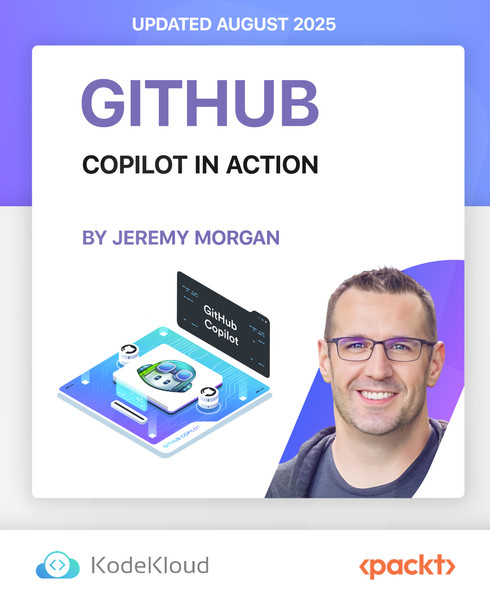
GitHub Copilot in Action by Jeremy Morgan [2025, ENG + Sub]

Year of release : August 2025
Manufacturer : Published by KodeKloud and Packt Publishing via O’Reilly Learning
Manufacturer’s website : Code:Copy to clipboard

https://learning.oreilly.com/course/github-copilot-in/9781806382279/

GitHub Copilot in Action
Author : Jeremy Morgan
Duration : 2h 30m
Type of distributed material : Video lesson
Language : En + subtitles

Description:
In this 2-hour course, you’ll master GitHub Copilot, transforming the way you write code. From setting up Copilot in Visual Studio to creating APIs and backend systems, you will learn how to integrate AI-assisted pair programming into your workflow, boosting productivity and enhancing your coding efficiency.
What I will be able to do after this course
Understand how GitHub Copilot aids in AI-assisted pair programming
Set up GitHub Copilot with Visual Studio for seamless integration
Create fake data generators, APIs, and backend systems using Copilot
Implement comment-driven development for faster coding and testing
Write in-code documentation and generate unit tests efficiently
Course Instructor(s)
KodeKloud, founded by Mumshad Mannambeth, is a leading platform in DevOps, Cloud Computing, and Automation. Mumshad has deep expertise as a Solutions Architect at Dell EMC and specializes in cloud deployment and automation.

Who is it for?
This course is ideal for software developers, engineers, and programmers looking to integrate AI into their development process. A working knowledge of programming and Visual Studio is recommended.

Content
Chapter 1 Introduction to GitHub Copilot
Chapter 2 Core Features
Chapter 3 Using Copilot Efficiently

Example files : none
Video format : MP4
Video : AVC, 1920×1080, 16:9, 30,000 fps, 3,000 kbps (0.017 bit/pixel)
Аудио: AAC, 44.1 KHz, 2 channels, 128 kb/s, CBR

⋆🕷- – – – -☽───⛧ ⤝❖⤞ ⛧───☾ – – – -🕷⋆

GitHub Copilot in Action (2025) (777.68 MB)
UsersDrive Link(s)
Code:Copy to clipboard

https://usersdrive.com/gjrdtm2fva9j.html

RapidGator Link(s)
Code:Copy to clipboard

https://rapidgator.net/file/dbb9a7b332da4e921fff375be4fcaed1/GitHub.Copilot.in.Action.2025.rar

GitHub Actions – The Complete Guide

Year of release : 1/2025
Manufacturer : UDEMY, Maximilian Schwarzmüller
Author : Code:Copy to clipboard

https://www.udemy.com/course/github-actions-the-complete-guide/

Duration : 10:17:48
Type of material given : Video lesson
Language : En
Description:
What you’ll learn
Use GitHub Actions to build automated workflows & processes

Automate code-based and project-based tasks

Run simple and complex workflows on a broad variety of triggers

Build powerful CI / CD workflows, including runtime configuration, security and conditional execution

Build custom actions or leverage public community solutions

How to secure GitHub Action workflows

Requirements
Basic Git & GitHub knowledge is strongly recommended (but the course offers a refresher module)

Basic development knowledge is recommended but not strictly required

NO prior GitHub Actions knowledge is required
Description
GitHub Actions is an extremely popular and fast-growing CI / CD automation service offered by GitHub.
This course teaches GitHub Actions from the ground up, without any prior GitHub Actions knowledge assumed or required.
In order to handle growing development and code complexity and deploy application updates with high frequency, powerful automation platforms and tools are required. As you will learn throughout this course, GitHub Actions is such a platform, enabling you to automate anything from code testing, building and deployment all the way up to GitHub repository and project management.
With this course, you’ll learn:
About all key GitHub Actions building blocks & components

How to build and orchestrate both simple and complex workflows

How to connect workflows to events & configure event details

How to run jobs or job steps conditionally

How to manage environment variables

How to handle job results, outputs and inputs

How to leverage community actions

How to build custom actions

How to secure workflows and jobs

And much more!
This course requires no prior GitHub Actions knowledge. You also don’t need to be an advanced developer or Git / GitHub user, though fundamental development and Git knowledge is recommended – though the course does come with a Git & GitHub refresher module.
This course is a practice-oriented courses, exploring all key concepts whilst diving into concrete examples. You’ll build different workflows for multiple projects and requirements.
You will also learn how to interact with GitHub APIs and implement third-party (and custom) Actions into your workflows.
Who this course is for:
Developers who want to explore DevOps solutions & workflow automation

Beginner or advanced DevOps practitioners who want to learn GitHub Actions

Everyone who’s looking to automated code-based tasks
Format Video : mp4
Video : avc, 1280×720, 16: 9, 30000k / s, 756Kb / s
Audio : AAC, 48.0KGC, 128KB / s, 2 audio

⋆🕷- – – – -☽───⛧ ⤝❖⤞ ⛧───☾ – – – -🕷⋆

Udemy – GitHub Actions – The Complete Guide (2025-1) (3.69 GB)

ClickNUpload Link(s)
Code:Copy to clipboard

https://clicknupload.click/ivxk6zli8n0i
https://clicknupload.click/jqe7w377i6cz

RapidGator Link(s)
Code:Copy to clipboard

https://rapidgator.net/file/7e7915cee5497fab7ec8c5bdee2dc337/Udemy.-.GitHub.Actions.-.The.Complete.Guide.2025-1.part1.rar
https://rapidgator.net/file/4c645ecc2c671a02211c752938746807/Udemy.-.GitHub.Actions.-.The.Complete.Guide.2025-1.part2.rar

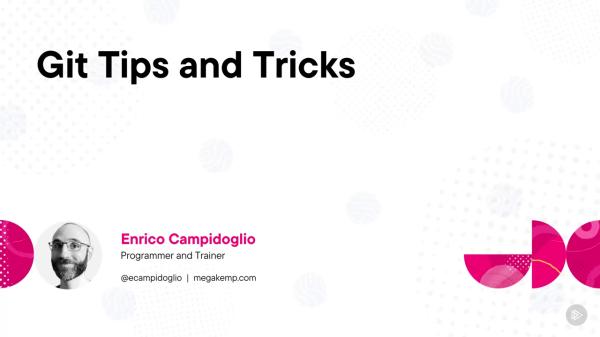
Git Tips and Tricks

Year of manufacture : 2024
Manufacturer : Pluralsight
Manufacturer’s website : Code:Copy to clipboard

https://www.pluralsight.com/courses/git-tips-tricks

Author : Enrico Campidoglio
Duration : ~2h23m
Type of material distributed : Video lesson
Language : En
Описание: If you’ve been using Git for a while, then you probably know how to use it like any other version control system: you commit files, review changes, and create and merge branches. However, Git is unique because it puts you in complete control of your source code history. In this course, Git Tips and Tricks, you’ll learn how to use Git’s lesser-known features to improve your daily workflow. First, you’ll look at how to use Git efficiently from the command line to help you find a method that fits your workflow and maintains a good-looking history. Next, you’ll discover how to track commits across branches and recover from seemingly disastrous mistakes. Finally, you’ll learn how to debug using Git. When you’re finished with this course, you’ll have the skills and knowledge of Git’s hidden features needed to maximize the potential of your workflow.
Content
Course Overview
2mins
Course Overview 2m
Embracing the Command Line
9mins
Why This Course? 1m
CLI vs. GUI 3m
The Tools 1m
Git Fundamentals 4m
Elevating Your Command Line Experience
22mins
Command Line Utilities 4m
Aliases 4m
Pretty Logs 3m
Pretty Diffs 6m
Inspecting Commits 5m
Summary 1m
Keeping a Clean History
30mins
The Importance of a Clean History 2m
Anatomy of a Good Commit 5m
Atomic Commits 7m
Consistent Commits 4m
Incremental Commits 5m
Documented Commits 4m
Private vs. Public History 3m
Summary 1m
Searching Through History
24mins
The Concept of Reachability 7m
When Was This Merged? 5m
Commits vs. Patches 3m
When Was This Changed? 5m
Who Changed It? 4m
Summary 1m
Merging the Right Way
31mins
The Power of Git’s Branching Model 6m
Different Kinds of Branches 4m
Different Ways of Merging 8m
Resolving Conflicts 7m
Ours vs. Theirs 2m
Reusing Recorded Resolutions 3m
Summary 1m
Fixing Mistakes
24mins
Amending Commits 9m
Git Undo 5m
Recovering Lost Commits 4m
Debugging with Bisect 5m
Summary 1m
Example files : present
Video format : MP4
Video : AVC, 1280×720, 16:9, 30fps, ~200kbps
Audio : AAC, 48kHz, 96kbps, stereo

⋆🕷- – – – -☽───⛧ ⤝❖⤞ ⛧───☾ – – – -🕷⋆

Pluralsight – Git Tips and Tricks By enrico-campidoglio (248.52 MB)

Drop Link(s)
Code:Copy to clipboard

https://drop.download/jxr7md1qpisx/Pluralsight.-.Git.Tips.and.Tricks.By.enrico-campidoglio.rar

RapidGator Link(s)
Code:Copy to clipboard

https://rapidgator.net/file/45a63af970388812ce0e2c1b4e33aca4/Pluralsight.-.Git.Tips.and.Tricks.By.enrico-campidoglio.rar

Git & GitHub – The Practical Guide (09/2021)


Git & GitHub – The Practical Guide

WEBRip | English | MP4 | 1920 x 1080 | AVC ~1818 Kbps | 30 fps
AAC | 62.7 Kbps | 48.0 KHz | 2 channels | Subs: English (.srt) | ~10.5 hours | 2.54 GB Genre: eLearning Video / Development, Web Development, Git

Learn Git & GitHub and master working with commits, branches, the stash, cherry picking, rebasing, pull requests & more! Click to expand… What you’ll learn
Learn all you need to work with Git, including all about repositories, commits, branches & more
Understand how Git works behind the scenes and understand local & remote as well as local-tracking & remote-tracking branches
Dive into advanced Git features like merging, rebasing, the stash and learn how to manage merge conflicts
Bring Git’s power to the cloud with GitHub
Learn how to collaborate in projects via Git & GitHub in teams & organizations
Learn how to contribute to open-source projects via forks & pull requests
Efficiently manage projects with Git & GitHub

Requirements
NO prior Git or GitHub or web development knowledge is required
An email address is required to create a (free) GitHub account
The course can be attended on Mac & Windows computers

Description
No matter if you’re just getting started with (web) development, if you’re applying for a developer job or if you just need to refresh your knowledge – version control is a core skill you need to succeed as a developer! Git (a version control system) and Github (a cloud provider for Git managed projects) form an outstanding combination to provide the best possible experience to create and maintain a clearly structured project history!

This course will guide everyone (no prior knowledge is required!) through the core steps to use these tools in your daily projects with ease.

What is Version Control?

Saving & accessing data and tracking changes is what version control is all about. No matter if you’re working on a private or a professional development project, code evolves, changes and continuously gets improved. A clean version management structure is therefore key to successfully manage the progress of your projects.

What is Git?

Git is a 100% free version management tool, specifically created for and used by developers all over the world to manage project code history locally on their machines (Windows, macOS, Linux/Unix).

What is GitHub?

GitHub is an online service, it is also free for many use cases (an account is all you need) and brings Git’s local "file-tracking" strengths to the cloud. Storing project code online, updating code, accessing other team members’ code or collaborating on large scale projects inside your organization – all possible with the help of GitHub!

Why Should I Know these Tools?

Version control is key to manage projects efficiently so not knowing Git and GitHub makes your daily developer life a lot more complicated. The same apply if you’re currently looking for a new job in the industry, version control is required in any developer projects these days, so not knowing Git & GitHub puts you behind your competition!

Although Git and GitHub are user friendly, both come with their own logic and "language". Getting started can therefore be a bit cumbersome and this is where this course comes into play!

What do I Learn in this Course?

This course starts at the very basics, no prior Git or GitHub knowledge is required! You’ll learn how to use Git and how to write Git commands in the Mac Terminal or the Windows Command Prompt (optional refreshers on both are also part of the course).

Starting with the first initialization of a so-called Git repository, we’ll build up your knowledge step-by-step and understand the what & why behind concepts like branches, commits, the staging area, merging & rebasing, cloning, pushing & pulling branches and a lot more!

What’s Inside this Course?

An optional Command Line Crash Course for both Windows & MacOS users

Git Download & Installation

Git Theory – Working Directory, Staging Area (Index) and Repository explained

Creating Git Repositories

Working with Commits

Understanding Branches

Understanding the HEAD and the detached HEAD

Newly Introduced Git Commands with Git Version 2.23

Deleting Data (Staged & Unstaged, Commits & Branches)

Ignoring Files

The Stash

Merging, Rebasing and Cherry Picking

Bringing Back Deleted Data with the Reflog

Connecting Local Git Repositories to Remote GitHub Repositories

Git Push & Pull (+ Fetch)

Local, Remote Tracking & Remote Branches

GitHub Collaborators & Contributors

Forks & Pull Requests

GitHub Issues

Github Projects

and so much more!

All covered, explained and applied in easy to understand examples in the course!

In this course we’ll find answers to questions like:

"How can I delete my last commit?"

"What is the Stash?"

"What is the difference between a merge and a rebase (and what is cherry-picking actually)?"

"How to bring back a deleted commit?"

"What is the difference between a local tracking branch and a remote tracking branch?"

What are you waiting for, jump and board and let’s GIT started

Who this course is for:
Anybody who wants to learn what version management is & how it can help to organize your code and projects efficiently
(Web) developers who want to learn new skills to increase their efficiency
Anybody who wants to master Git & GitHub for private or professional projects

also You can find my other useful:

General
Complete name : 030 Installing Git on MacOS.mp4
Format : MPEG-4
Format profile : Base Media
Codec ID : isom (isom/iso2/avc1/mp41)
File size : 66.7 MiB
Duration : 4 min 44 s
Overall bit rate : 1 967 kb/s
Writing application : Lavf58.76.100

Video
ID : 1
Format : AVC
Format/Info : Advanced Video Codec
Format profile : Main@L4
Format settings : CABAC / 4 Ref Frames
Format settings, CABAC : Yes
Format settings, RefFrames : 4 frames
Format settings, GOP : M=4, N=60
Codec ID : avc1
Codec ID/Info : Advanced Video Coding
Duration : 4 min 44 s
Source duration : 4 min 44 s
Bit rate : 1 818 kb/s
Nominal bit rate : 4 800 kb/s
Maximum bit rate : 1 899 kb/s
Width : 1 920 pixels
Height : 1 080 pixels
Display aspect ratio : 16:9
Frame rate mode : Constant
Frame rate : 30.000 FPS
Color space : YUV
Chroma subsampling : 4:2:0
Bit depth : 8 bits
Scan type : Progressive
Bits/(Pixel*Frame) : 0.029
Stream size : 61.7 MiB (92%)
Source stream size : 64.4 MiB (96%)
Writing library : x264 core 148
Encoding settings : cabac=1 / ref=3 / deblock=1:0:0 / analyse=0x1:0x111 / me=umh / subme=6 / psy=1 / psy_rd=1.00:0.00 / mixed_ref=1 / me_range=16 / chroma_me=1 / trellis=1 / 8x8dct=0 / cqm=0 / deadzone=21,11 / fast_pskip=1 / chroma_qp_offset=-2 / threads=24 / lookahead_threads=4 / sliced_threads=0 / nr=0 / decimate=1 / interlaced=0 / bluray_compat=0 / constrained_intra=0 / bframes=3 / b_pyramid=2 / b_adapt=1 / b_bias=0 / direct=1 / weightb=1 / open_gop=0 / weightp=2 / keyint=60 / keyint_min=6 / scenecut=0 / intra_refresh=0 / rc_lookahead=60 / rc=cbr / mbtree=1 / bitrate=4800 / ratetol=1.0 / qcomp=0.60 / qpmin=0 / qpmax=69 / qpstep=4 / vbv_maxrate=4800 / vbv_bufsize=9600 / nal_hrd=none / filler=0 / ip_ratio=1.40 / aq=1:1.00
mdhd_Duration : 284505

Audio
ID : 2
Format : AAC
Format/Info : Advanced Audio Codec
Format profile : HE-AAC / LC
Format settings : Implicit
Codec ID : mp4a-40-2
Duration : 4 min 44 s
Bit rate mode : Constant
Bit rate : 62.7 kb/s
Channel(s) : 2 channels
Channel positions : Front: L R
Sampling rate : 48.0 kHz / 24.0 kHz
Frame rate : 23.438 FPS (1024 SPF)
Compression mode : Lossy
Stream size : 2.13 MiB (3%)
Default : Yes
Alternate group : 1
Screenshots

Exclusive eLearning Videos ← add to bookmarks

GIAC Security Leadership Certificate (GSLC) Prep Course


2.87 GB | 8min 14s | mp4 | 1280X720 | 16:9
Genre:eLearning |Language:English
Files Included :
01-About Course.mp4 (51.56 MB)
02-Meet Course Designer & Training Architect.mp4 (33.2 MB)
03-Why GIAC Certifications.mp4 (11.83 MB)
04-Do You Need SANS or GIAC-Affiliated Training.mp4 (10.14 MB)
05-Pre-Requisites For This Course.mp4 (13.21 MB)
06-Role of a Modern Security Leader.mp4 (25.42 MB)
07-Cybersecurity Frameworks Control, Program, & Risk Models.mp4 (21.73 MB)
08-Risk Fundamentals & Calibration for Managers.mp4 (22.32 MB)
09-Practical Risk Assessment & Risk Management Techniques.mp4 (49.66 MB)
10-Developing Effective & Actionable Security Policies.mp4 (39.81 MB)
11-Planning & Managing the Policy Lifecycle.mp4 (34.94 MB)
12-Structuring a Security Program Governance & Reporting Lines.mp4 (22.76 MB)
13-Understanding the Three Lines of Defense.mp4 (23.81 MB)
14-Roles, Responsibilities, & Security Functions.mp4 (25.57 MB)
15-Security Architecture Principles, Models, Trends & Frameworks.mp4 (60.58 MB)
16-Cyber Defense Matrix Mapping Controls to Function.mp4 (26.02 MB)
17-Layered Network Security (Layer 1 to Application Layer).mp4 (31 MB)
18-Network Security Layer 1 & 2 Overview & Attacks.mp4 (40.73 MB)
19-Network Security Layer 3 VPNs & IPSec.mp4 (28.66 MB)
20-Network Security Layer 4 TCP & UDP.mp4 (31.63 MB)
21-Network Security Application Layer Proxies, NGFW, IDSIPS, NSM.mp4 (51.29 MB)
22-Host Security Malware & Attack Examples.mp4 (39.42 MB)
23-Host Security Controls-EPP, EDR, HIDS-HIPS, FIM, Allowlisting, & Sandboxing.mp4 (31.28 MB)
24-Cloud Security Fundamentals.mp4 (49.43 MB)
25-Microsoft AWS Security Reference Architecture.mp4 (92.21 MB)
26-Cloud Security Attack Examples & Controls.mp4 (31.85 MB)
27-Cloud Security Tools-CSPM, CWPP, & CASB.mp4 (26.64 MB)
28-Cloud Security Models-CSA, CAF, & Well-Architected Framework.mp4 (38.72 MB)
29-IAM Overview-Authentication Factors & Access Risks & IAM Security Capabilities.mp4 (34.56 MB)
30-Zero Trust Principles & Best Practices, ZTNA & Variable Trust.mp4 (63.28 MB)
31-Introduction to Security Engineering.mp4 (35.17 MB)
32-Cryptography Essentials-CIA, Non-Repudiation, Hashing & Digital Signatures.mp4 (46.85 MB)
33-Symmetric Vs Asymmetric Encryption & Key Exchange.mp4 (44.39 MB)
34-Applied Encryption-TLS, PKI, Blockchain, & Quantum.mp4 (65.46 MB)
35-Privacy Vs Security Concepts & Legal Foundations.mp4 (39.64 MB)
36-Privacy Engineering & Compliance Controls.mp4 (58.73 MB)
37-Secure Application Development-SDLC & Threats.mp4 (46.85 MB)
38-Application Attacks-OWASP Top 10.mp4 (42.03 MB)
39-Application Security-Application Security Testing Tools.mp4 (41.26 MB)
40-DevSecOps, Toolchains & CICD Pipeline.mp4 (71.22 MB)
41-Infrastructure as Code (IaC).mp4 (33.33 MB)
42-Container Security.mp4 (31.44 MB)
43-Introduction to GenAI & Transformer Architectures.mp4 (36.25 MB)
44-Security Risks in LLMs-OWASP Top 10 for LLMs, MITRE ATLAS, & Key Threats.mp4 (77.56 MB)
45-GenAI Risk Mitigations & NIST AI RMF Controls.mp4 (36.9 MB)
46-Building Secure AI Policies.mp4 (46.02 MB)
47-AI Security Tools & Mitigations.mp4 (46.98 MB)
48-Security Leadership in Action-Traits & Mindsets.mp4 (33.48 MB)
49-Vulnerability Management Lifecycle & PIACT Process.mp4 (43.13 MB)
50-Prioritizing Vulnerabilities with CVSS & Context.mp4 (48.87 MB)
51-Finding, Fixing & Communicating Vulnerabilities.mp4 (62.33 MB)
52-Security Awareness Program-Maturity Model.mp4 (39.67 MB)
53-Human Risk Factors & Cultural Transformation.mp4 (71.72 MB)
54-Security Negotiation Strategies for Influence.mp4 (50.96 MB)
55-Vendor & Product Analysis Using AHP.mp4 (34.61 MB)
56-Project Management for Security Initiatives.mp4 (49.38 MB)
57-Leading High-Performance Security Teams.mp4 (46.7 MB)
58-Logging, Monitoring, & Visibility Fundamentals.mp4 (87.61 MB)
59-SIEM Deployment & Optimization Best Practices.mp4 (59.76 MB)
60-Security Operations Center Models & Functions.mp4 (61.79 MB)
61-Tiered Vs Tierless SOC Structures.mp4 (23.9 MB)
62-Incident Response Lifecycle Using PICERL.mp4 (37.82 MB)
63-Business Continuity Planning (BCP) Fundamentals.mp4 (47.66 MB)
64-Disaster Recovery (DR) Strategies & Testing.mp4 (71.55 MB)
65-Physical Security Controls & Risk Examples.mp4 (63.83 MB)
66-Key Takeaway for You as a Security Leader.mp4 (16.77 MB)
67-Continued Learning Resources.mp4 (41.79 MB)
68-Certification Guidance & Format.mp4 (26.02 MB)
69-Course Feedback & Closing Remarks.mp4 (14.19 MB)]
Screenshot

Getting Started with Pulumi

Year of release : 2022
Manufacturer : Pluralsight
Author : Floyd May
Duration : 1h 32m
Type of distributed material : Video clips
Language : En
Subtitles : En
Описание: Managing cloud infrastructure can often be a challenge of wrangling obtuse configuration files or manually configuring resources through your cloud provider’s web console. In this course, Getting Started with Pulumi, you’ll learn the basics of managing cloud infrastructure using your favorite programming language. First, you’ll explore creating, modifying, and destroying cloud resources in providers like AWS, GCP, and Azure. Next, you’ll discover how to create dependencies between resources – servers, databases, storage, DNS, and more – so that they are dynamically configured to work together. Finally, you’ll learn how to make reusable groups of resources so that you can create and destroy independent replicas of your environments for testing or demos. When you’re finished with this course, you’ll be ready to start using Pulumi to manage your cloud infrastructure.
Content
Course Overview 1m 29s
Your First Pulumi Project 13m 46s
Managing Resources with Relationships 31m 23s
Incorporating Multiple Providers 16m 13s
Troubleshooting When Deployments Fail 10m 43s
Designing Pulumi Stacks for Reuse 19m 14s
Example files : none
Video format : MP4
Видео: MPEG4 Video (H264) 1024×768 30fps 293kbps [V: En [eng] (h264 high L4.0, yuv420p, 1280×720, 293 kb/s)]
Аудио: AAC 44100Hz stereo 95kbps [A: SoundHandler [eng] (aac lc, 44100 Hz, stereo, 95 kb/s)]

⋆🕷- – – – -☽───⛧ ⤝❖⤞ ⛧───☾ – – – -🕷⋆

Getting Started with Pulumi (154.38 MB)
RapidGator Link(s)
Code:Copy to clipboard

https://rapidgator.net/file/c91a9c249d661f2502373a0e3965fc26/Getting.Started.with.Pulumi.rar

Drop Link(s)
Code:Copy to clipboard

https://drop.download/ou66bdysric6/Getting.Started.with.Pulumi.rar